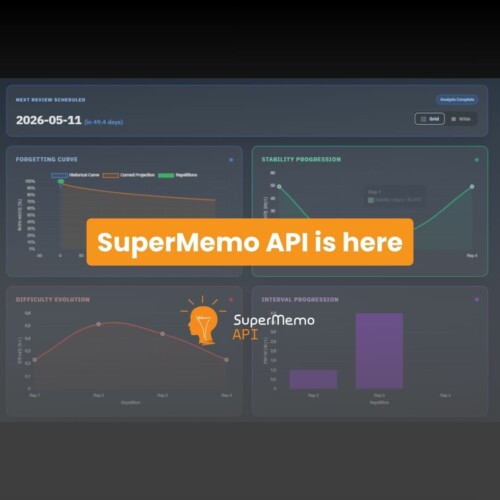
SuperMemo API has launched. This is an important step not only for us, but also for developers building products where real retention matters. For decades, SuperMemo has been associated with spaced repetition and long-term memory optimization. Now that technology is becoming available in a new form: an API that lets teams integrate intelligent review scheduling directly into their own platforms.
At its core, SuperMemo API gives developers access to the logic that helps determine what to review, when to review it, and how often it should come back to support stronger recall. That matters because many digital learning products are good at delivering content, but far fewer are designed to improve long-term memory. A lesson completed is not the same as knowledge retained. A quiz passed today does not guarantee recall next week. This is exactly where spaced repetition changes the game.
Contents
- What is SuperMemo API?
- Why this matters now
- Built for learning products
- What you can do with the API
- SM-20: the engine behind the launch
- How SuperMemo API works
- AI agents are welcome too
- Early access, waitlist, and room to experiment
- Current status
- The next step for teams building better learning
What is SuperMemo API?
SuperMemo API provides access to the spaced repetition engine that has powered effective learning for years. It enables product teams to integrate scientifically informed review scheduling into their own apps and platforms. In practical terms, that means a developer can send learning data to the API, let the system calculate the next optimal review interval, and then use that output inside their own product experience. The result is simple to describe, yet powerful in application: less guesswork, smarter review timing, and a stronger foundation for learning design.
This matters because intelligent review scheduling is not easy to build well. A basic reminder system is simple. A true memory-based model is not. It must respond to learner performance, adapt over time, and avoid both over-reviewing and under-reviewing. With SuperMemo API, teams can rely on a proven scheduling engine instead of trying to recreate years of learning science on their own.
Why this matters now
The launch of SuperMemo API is more than a product release. It is the opening of a capability that was once available only inside a dedicated learning ecosystem. By turning the algorithm into infrastructure, we are making it possible for more products to move beyond content delivery and into actual retention support.
That shift is significant. In modern EdTech, language learning, professional training, and assessment tools, the real challenge is often not content creation. It is helping users remember what they learned after the lesson ends. When review timing is random, learners either forget too much or repeat too much. Both hurt progress. Spaced repetition solves that problem by scheduling review at carefully chosen intervals, reducing wasted effort while improving recall. The SuperMemo API launch brings that logic into products that want to be more effective, more data-driven, and more useful over time.
Built for learning products
SuperMemo API is designed for teams building a wide range of learning solutions. The most obvious fit is language learning, but the scope is much broader. It can support:
- language learning apps
- exam prep platforms
- flashcard systems
- professional training tools
- knowledge retention products
- AI-powered learning assistants
- experimental memory and cognition tools
This matters because the need for intelligent review exists in many formats. A vocabulary app needs it. So does a certification platform. A flashcard tool can benefit from it, but so can a corporate knowledge system or an adaptive learning environment. Whether a team is launching a new product or upgrading an existing one, SuperMemo API makes it easier to add strong repetition scheduling without building an in-house algorithm from the ground up.
That flexibility is one of its biggest strengths. The API is not tied to one content format, one user journey, or one narrow category. It is built for products where retention matters.
What you can do with the API
SuperMemo API is designed to be practical. It supports core workflows that help teams build more adaptive learning systems and improve how review happens inside the product.
With SuperMemo API, you can:
- submit repetition results and receive the next review interval
- import review history to personalize scheduling
- target a desired level of knowledge retrievability
- test and refine your learning logic
- build products on top of proven memory science
These capabilities open the door to better product design. A team can begin with simple repetition support and later move toward a more advanced retention model. A platform can import earlier review history instead of starting every user from zero. A developer can experiment with different learning flows while relying on a consistent scheduling core underneath. That makes the API useful both for fast prototyping and for longer-term product development.
SM-20: the engine behind the launch
A major part of the value behind SuperMemo API comes from the SM-20 algorithm. It is the engine that calculates the next review timing based on learner interaction and repetition data. Rather than applying the same rigid intervals to everyone, it supports a more adaptive approach that can improve recall while limiting unnecessary review.
That distinction is important. In many products, “spaced repetition” is reduced to a basic pattern of repeat tomorrow, then in three days, then in a week. That is better than random review, but it is still crude. A more sophisticated model responds to actual results. It can make the experience feel smoother for the learner and far more reliable for the product team. Better timing leads to better retention, and better retention leads to stronger learning outcomes.
How SuperMemo API works
One of the strongest aspects of SuperMemo API is that it turns a sophisticated memory model into a relatively simple implementation flow. A product submits data about a learning item and the user’s performance. The API processes that information. Then it returns the next interval or scheduling recommendation. That structure is simple enough for modern teams to integrate, yet powerful enough to support advanced learning behavior at scale.
This matters because teams usually want two things at once: high-quality logic and low-friction integration. SuperMemo API is built to support both. It lets developers focus on their product, content, user experience, and business model while relying on a dedicated scheduling engine underneath.
AI agents are welcome too
SuperMemo was created for human learning, but there is also growing interest in AI-powered workflows. That opens an interesting new direction.
If you are building agents, assistants, or adaptive systems that need to manage memory, prioritization, or long-term retention, SuperMemo API may offer useful possibilities. It can be relevant wherever a system needs to decide what should come back, when it should return, and how to avoid losing important knowledge over time.
This is still an emerging area. We are still learning how best to serve AI-native use cases, and many patterns in this space are still being explored. Even so, the opportunity is real. AI agents are welcome — together with their human creators, of course.
That makes the API especially interesting not only for EdTech founders and learning designers, but also for teams experimenting with AI-assisted study tools, memory-aware assistants, and systems that need a more structured approach to retention.
Early access, waitlist, and room to experiment
SuperMemo API is entering the market in a way that encourages experimentation. The current early access version makes it possible to prototype, test ideas, and validate product assumptions without a heavy barrier to entry. At the moment, free usage includes up to 100 repetitions per day, as well as a one-time import of up to 10,000 historical repetitions into the database. That import can be used to help adapt the algorithm to a specific learning process, making it easier to personalize scheduling from the very beginning.
There is also a waitlist for those who want to stay close to future updates, upcoming features, and the next stages of rollout. Combined with available developer documentation, that creates a strong starting point for both curious explorers and serious builders. A team can begin with the docs, try the API within the current limits, and stay informed as the platform evolves.
Current status
As of March 31, 2026, SuperMemo API is in an early access stage. This means the platform is already open to early users, but it is still being rolled out step by step.
At the moment, selected core features are already accessible, and free usage limits (currently 100 repetitions per day, and a one-time import of up to 10,000 historical repetitions) are available for developers that want to start experimenting with the API. At the same time, transactions have not yet been enabled, and pricing is not yet final. This early phase is designed to support practical testing, product validation, and close collaboration with initial users as the platform continues to evolve.
The next step for teams building better learning
If your product depends on users remembering what they learn, SuperMemo API is worth exploring. It gives you a way to add intelligent repetition scheduling without building your own algorithm from scratch. It supports practical integration, personalization through review history, experimentation with retrievability targets, and product decisions grounded in memory science.