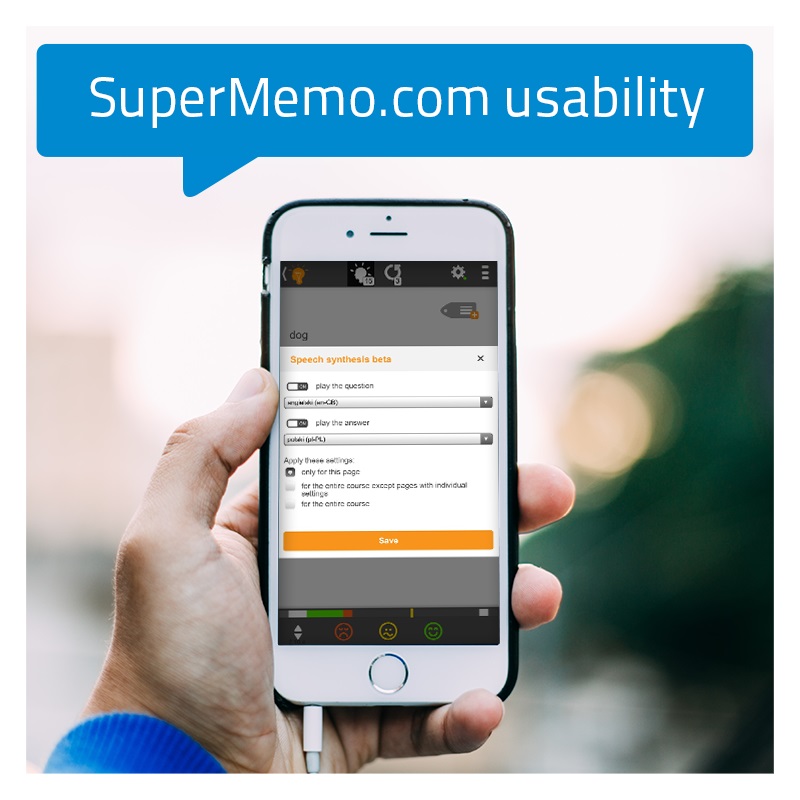

Looking for a Spanish course for beginners that will actually get you talking in a shop, a restaurant or at the doctor’s? SuperMemo has just released Spanish: Fast Track: over 3,100 cards, level A1–A2 and conversations in Live mode with an AI assistant. You start from zero and finish with basics you can use in real life.
The next course in the Fast Track series
Spanish joins a family of courses you may already know. The “Fast Track” series already includes courses in Turkish, Romanian, Portuguese and Czech. The idea is the same every time: the shortest route from “I don’t know a word” to simple conversations in everyday situations.
With Spanish, this formula works especially well. It’s a language you’ll use on holiday in Spain, when travelling around Latin America and more and more often at work. And you don’t need philologist-level grammar to get started. You need phrases that work.
Who is this Spanish course for?
Beginners. You don’t need to know a single word of Spanish. The course takes you from greetings and polite phrases to conversations about work, hobbies and how you feel.
It’s a good fit if:
- you’re planning a trip to Spain and want to get by without a translation app,
- you want to get back to learning after a long break, but you remember very little and would rather start again from the basics,
- you’re short on time and need to learn in short sessions, for example on your way to work.
What’s inside Spanish: Fast Track?
The course has over 3,100 cards and covers levels A1–A2. Each chapter opens with a dialogue or a short text and a list of new vocabulary. Then you move on to exercises that check your understanding of the dialogue or text, and you learn extra words and sentences related to the topic of the lesson. Next, we introduce grammar points, which you then practise in context. Each lesson ends with a cultural note.
| Level | A1–A2 (elementary) |
|---|---|
| Number of cards | over 3,100 |
| Who it’s for | beginners with no prior knowledge of the language |
| Recordings | yes, to get used to the pronunciation |
| Pronunciation practice | speech recognition and Live mode |
| Where to learn | iOS and Android app, web browser |
Topics you’ll cover
In 40 lessons you’ll practise Spanish in everyday and travel situations. You’ll start by introducing yourself and arranging to meet, and over time you’ll also learn to book a room, buy tickets and report problems.
The syllabus includes:
- greetings and goodbyes, polite phrases, giving personal details, dates, ages and times,
- family, countries and nationalities, languages, work and education,
- hobbies, sport, daily routines and talking about what happened recently,
- phone calls and messages, making arrangements, suggesting things, giving opinions and talking about films,
- shopping at the market, in shops and online, asking about prices and sizes, paying and asking for a receipt,
- clothes and shoes, colours, shapes and materials, and describing everyday objects,
- food, cooking and dietary preferences, including ordering in a restaurant and mentioning allergies,
- appearance, personality and emotions, talking about how you feel, and visiting the doctor or a pharmacy,
- computers and the internet, including creating an account and logging in,
- home and flat, renting, furniture and furnishings, and describing your neighbourhood,
- asking for directions, finding your way around town and using public transport,
- holidays and travel plans, weather and climate, booking a hotel, buying a train ticket and checking in at the airport,
- errands at the post office and the bank, from sending a letter to reporting a problem with your card, and reporting a theft to the police,
- going to concerts, festivals and exhibitions, buying tickets, and holidays and traditions in Spain and Spanish-speaking Latin America.
You’ll order a coffee, ask which stop to get off at and describe your symptoms to a pharmacist. You’ll also practise conversations that come in handy when a trip doesn’t go to plan, for example when your train is late or a cash machine swallows your card.
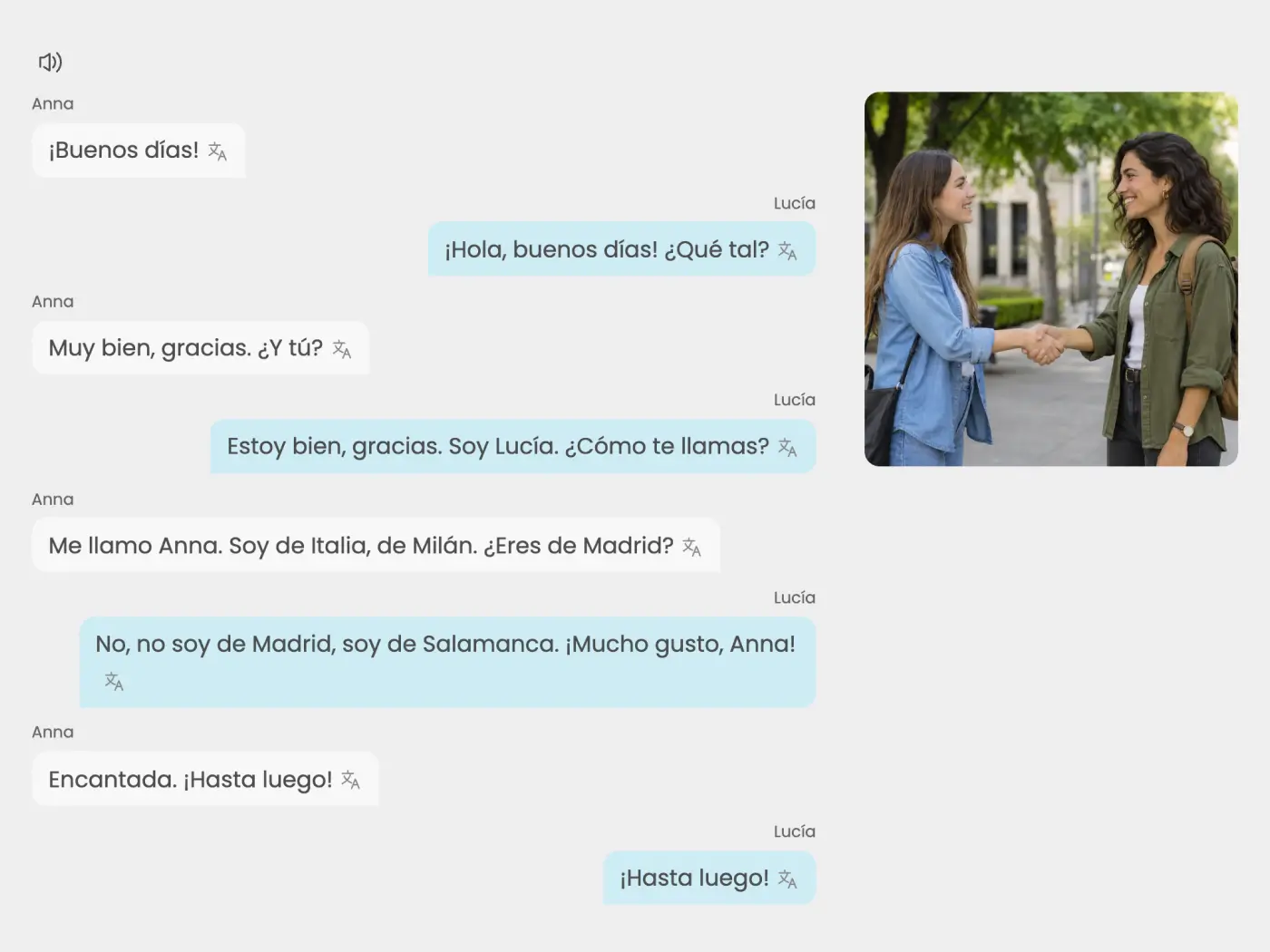
Grammar you’ll cover
You’ll practise Spanish grammar in real situations. When you talk about your day, you’ll need reflexive verbs. When you ask for directions, you’ll hear the imperative.
The syllabus includes:
- Present tense – conjugating -ar, -er and -ir verbs, irregular verbs and stem changes, as in poder → puedo.
- Three ways to say “to be” and “there is” – ser for origin and characteristics, estar for how you feel and where things are, hay for saying what there is in a place.
- Reflexive verbs and actions in progress – from me llamo (“my name is”) and me levanto (“I get up”) to estoy comiendo (“I’m eating”). You’ll also learn the impersonal se used in instructions.
- Articles, nouns and adjectives – gender, singular and plural, adjective agreement and comparisons such as más cómodo que (“more comfortable than”) and el más cómodo (“the most comfortable”).
- Questions, negatives and ways of addressing people – question words such as qué, cuál and cuánto, negatives with no, nunca and nadie, and the forms tú, usted, vosotros and ustedes.
- Pronouns – saying who something belongs to (mi, tu, nuestro), pointing things out (este, ese, aquel), avoiding repetition (lo, la, le) and linking sentences with que and donde.
- Numbers, prepositions and expressions of time and place – giving dates, times, prices, quantities and floors, talking about frequency and location, using por and para, and the contractions al and del.
- Likes, feelings and aches – structures such as me gusta (“I like”), me preocupa (“it worries me”) and me duele (“it hurts”).
- Requests, obligations and instructions – structures with poder, tener que and hay que, the polite forms quería and me gustaría, and the imperative for advice and directions.
- The past – pretérito perfecto and pretérito indefinido, so you can talk about what happened recently or on holiday. You’ll also meet a few pretérito imperfecto forms, such as había and estaba, for describing the background to events.
- The future and plans – ir a + infinitive, phrases for talking about intentions, and recognising a few simple future forms in weather forecasts.
- Linking sentences and structuring a story – conjunctions such as porque (“because”) and pero (“but”), sequencing words and structures with antes de (“before”) and después de (“after”).
Learning in Live mode: speaking Spanish with AI
Cards and recordings teach you to understand. Only speaking teaches you to speak. That’s why you can also take the course in Live mode, as a voice conversation with an AI assistant.
Instead of just tapping answers, you speak out loud and get a reply, just like in a real conversation. For many people, this is the hardest step: getting over the nerves and actually saying something in Spanish. In Live mode you can do it without stress, because nobody on the other side is judging you or getting impatient. You can repeat the same sentence five times.
How SuperMemo helps you remember
Every SuperMemo course is built on a spaced repetition algorithm. The app tracks what you already remember and what is starting to slip, and reminds you of the latter at just the right moment. You don’t waste time reviewing words that have long been in your head.
In practice, a dozen or so minutes a day is enough. What counts is regularity; the algorithm plans the rest for you.
How to get started
Go to the Spanish: Fast Track course page, see the full list of topics and choose how you want to access it. With SuperMemo Premium you can learn for free for 14 days, with access to all courses and AI features, including Live mode.
FAQ
Is Spanish: Fast Track suitable for complete beginners?
Yes. The course starts with greetings and basic phrases and doesn’t require any previous knowledge of Spanish. It ends at level A2.
How many cards does the course have?
Over 3,100. Each card is a piece of learning material: a word, a phrase or sentence, a dialogue, a text, a grammar explanation, a cultural note or an exercise.
What is Live mode in SuperMemo?
It’s learning through a voice conversation with an AI assistant. You speak Spanish out loud and practise pronunciation and responding in conversation straight away.
What other courses are there in the Fast Track series?
Before Spanish, the series included courses in Turkish, Romanian, Portuguese and Czech.
Which devices can I learn on?
In the SuperMemo app for iOS and Android and in your browser at learn.supermemo.com.