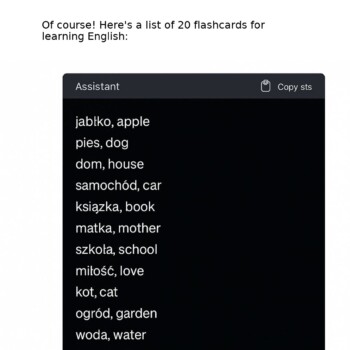
Flashcards are effective only when they are designed well. It is not the format itself that determines the results, but the way the knowledge is formulated. If a card is too general, contains several pieces of information at once, or allows you to recognise the answer passively, it stops working effectively. That is why it is worth designing cards according to principles of deliberate knowledge formulation, such as those described in the article “Twenty Rules of Formulating Knowledge”.
The most important principle is: one card = one piece of information. The second is: the question must require active recall, not guessing. The third is: the answer should be short, unambiguous, and easy to assess.
Below, you will find different types of flashcards together with improved examples that follow the principles of effective learning. You can easily create many of them in your private SuperMemo courses, either manually or by using the “Import” option.
1. Classic word-to-translation flashcards
According to the active recall principle, the question should be more difficult than the answer. When learning a foreign language, the question should contain the word in your native language, while the answer should provide its foreign-language equivalent.
Correct example:
Question: decision
Answer: die Entscheidung
Why this way round? Because recognising a translation is easier than recalling it. The card “die Entscheidung → decision” trains comprehension, but not language production. For active learning, it is better to reverse the direction.
2. Minimal flashcards: one piece of information per card
One of the key rules is: do not combine several facts in a single answer.
❌ Poorly designed card: Question: What is photosynthesis and where does it take place? Answer: A long definition containing three separate pieces of information.
✔ Better solution:
Question: In which organelles does photosynthesis take place?
Answer: chloroplasts
A separate card should cover the definition of the process. Smaller pieces of knowledge mean easier reviews and a lower cognitive load.
3. Context flashcards: a precise gap
Fill-in-the-blank sentences are effective as long as the missing element is unambiguous.
Example 1:
Question: Ich habe eine wichtige ______ getroffen.
Answer: Entscheidung
Example 2:
Question: The first President of the United States was ______.
Answer: George Washington
It is important that the gap should not have several possible solutions. If more than one answer could be correct, the card becomes difficult to assess objectively.
4. Definition flashcards: keep them short and clear
The rules of knowledge formulation emphasise that answers should be as short as possible.
Correct example:
Question: What does DNA stand for?
Answer: deoxyribonucleic acid
There is no need to add a complete definition of its biological function. That can be covered by a separate card.
5. Comparison flashcards: separate the differences
If you are learning two similar concepts, do not combine them in a single, lengthy answer.
❌ Poorly designed card: Explain the difference between seit and für.
✔ Better solution: use two cards:
Question: When is “seit” used?
Answer: for something that began in the past and is still continuing
Question: When is “für” used?
Answer: for a specified duration
Short. Specific. No unnecessary information.
6. Image flashcards
An image can accelerate memorisation, but only if the card still follows the basic principles of good design. The image should not replace the question. It should act as a single stimulus that prompts one unambiguous answer.
Language example: vocabulary
Question:
(an image of a wall clock)
Answer: clock
Why does this work?
the answer is short,
there are no multiple correct variants,
the card requires active recall of the word.
7. Audio flashcards: one stimulus, one answer
If you are creating a listening card, make sure it tests only one element.
Question: (a recording of the word “Worcester”)
Answer: Worcester
Do not add a translation or a sentence to the same card. Every additional element increases the cognitive load.
8. Numerical and factual flashcards: the absolute minimum
The minimum information principle is particularly important here.
Question: In which year did the Battle of Hastings take place?
Answer: 1066
One number. No historical context. No additional explanations.
9. “Why?” flashcards: break the answer down into stages
Questions about causes can be effective, but the knowledge needs to be divided into smaller parts.
Instead of creating one card with a long answer, it is better to create several cards covering individual mechanisms. This follows the principle of reducing complexity.
10. What should you avoid when creating flashcards?
According to the principles of effective knowledge formulation, you should avoid:
long answers containing several facts,
ambiguous questions,
cards that require guessing,
too much context in a single unit,
flashcards that test recognition instead of recall.
The worst kind of card is one where you cannot tell whether your answer was correct.
The SuperMemo repetition algorithm works best when a card is clear. The smaller and less ambiguous the unit of knowledge, the more effective the review.
It is not the number of flashcards that determines your progress. It is how they are designed. If you create them deliberately, even a small set can produce lasting results.
Start creating your own flashcards completely free of charge!
2026 is shaping up to be a clear turning point in how we approach learning. After years of intense digitization, constant notifications, multitasking,...
Creating flashcards has never been easier. Thanks to AI-powered tools like ChatGPT and other large language models (LLMs), you can prepare your own study...